Tuesday, November 27, 2012

Park Güell, Barcelona!

Park Güell is a garden complex with architectural elements  situated on the hill of El Carmel in the Gràcia district of Barcelona! Designed by Antonio Gaudi and built in the years 1900-1914. I loved this park it reminded of a gingerbread house candy land!


The park was originally part of a commercially unsuccessful housing site, the idea of Count Eusebi Güell, whom the park was named after.


The site was a rocky hill with little vegetation and few trees, called Muntanya Pelada (Bare Mountain). It already included a large country house called Larrard House or Muntaner de Dalt House, and was next to a neighborhood of upper class houses called La Salut. Count Eusebi Güell added to the prestige of the development by moving in 1906 to live in Larrard House. Ultimately, only two houses were built, neither designed by Gaudí. One was intended to be a show house, but on being completed in 1904 was put up for sale, and as no buyers came forward, Gaudí, at Güell's suggestion, bought it with his savings and moved in with his family and his father in 1906. The House is now the Gaudi House Museum.


It has since been converted into a municipal garden. It can be reached by underground railway (although the stations are at a distance from the Park and at a much lower level below the hill), by city buses, or by commercial tourist buses.


The Entry for the park is free. There is a fee to see Gaudi's house including the furniture he designed! There is a reduced rate for those wishing to see both Park Güell and the Sagrada Família Church.


Park Güell is skillfully designed and composed to bring the peace and calm that one would expect from a park. The buildings flanking the entrance, though very original with fantastically shaped roofs with unusual pinnacles, fit in well with the use of the park as pleasure gardens and seem relatively inconspicuous in the landscape when one considers the flamboyance of other buildings designed by Gaudí.


The focal point of the park is the main terrace, surrounded by a long bench in the form of a sea serpent. The curves of the serpent bench form a number of enclaves, creating a more social atmosphere.


Beautiful Tiles!


Gaudí incorporated many motifs of Catalan nationalism, and elements from religious mysticism and ancient poetry, into the Park.


Gaudí's multicolored mosaic salamander, popularly known as "el drac" (the dragon), at the main entrance.


The Salamander was vandalized in 2007.


Doric columns support the roof of the lower court which forms the central terrace, with serpentine seating round its edge.


One of Gaudí's unique ceiling tiles.


The large cross at the Park's high-point offers the most complete view of Barcelona and the bay. It is possible to view the main city in panorama, with the Sagrada Família and the Montjuïc area visible at a distance.


They were playing beautiful classical music inside this column area! It was very nice and calming!


The park supports a wide variety of wildlife, notably several of the non-native species of parrot found in the Barcelona area. Other birds can be seen from the park, with records including Short-toed eagle. The park also supports a population of Hummingbird hawk moths.


Roadways around the park to service the intended houses were designed by Gaudí as structures jutting out from the steep hillside or running on viaducts, with separate footpaths in arcades formed under these structures. His structures echo natural forms, with columns like tree trunks supporting branching vaulting under the roadway, and the curves of vaulting and alignment of sloping columns designed in a similar way to his Church of Colònia Güell so that the inverted catenary arch shapes form perfect compression structures.


Gaudi's Tile Mosaics! Love!


Kevin and I! <3
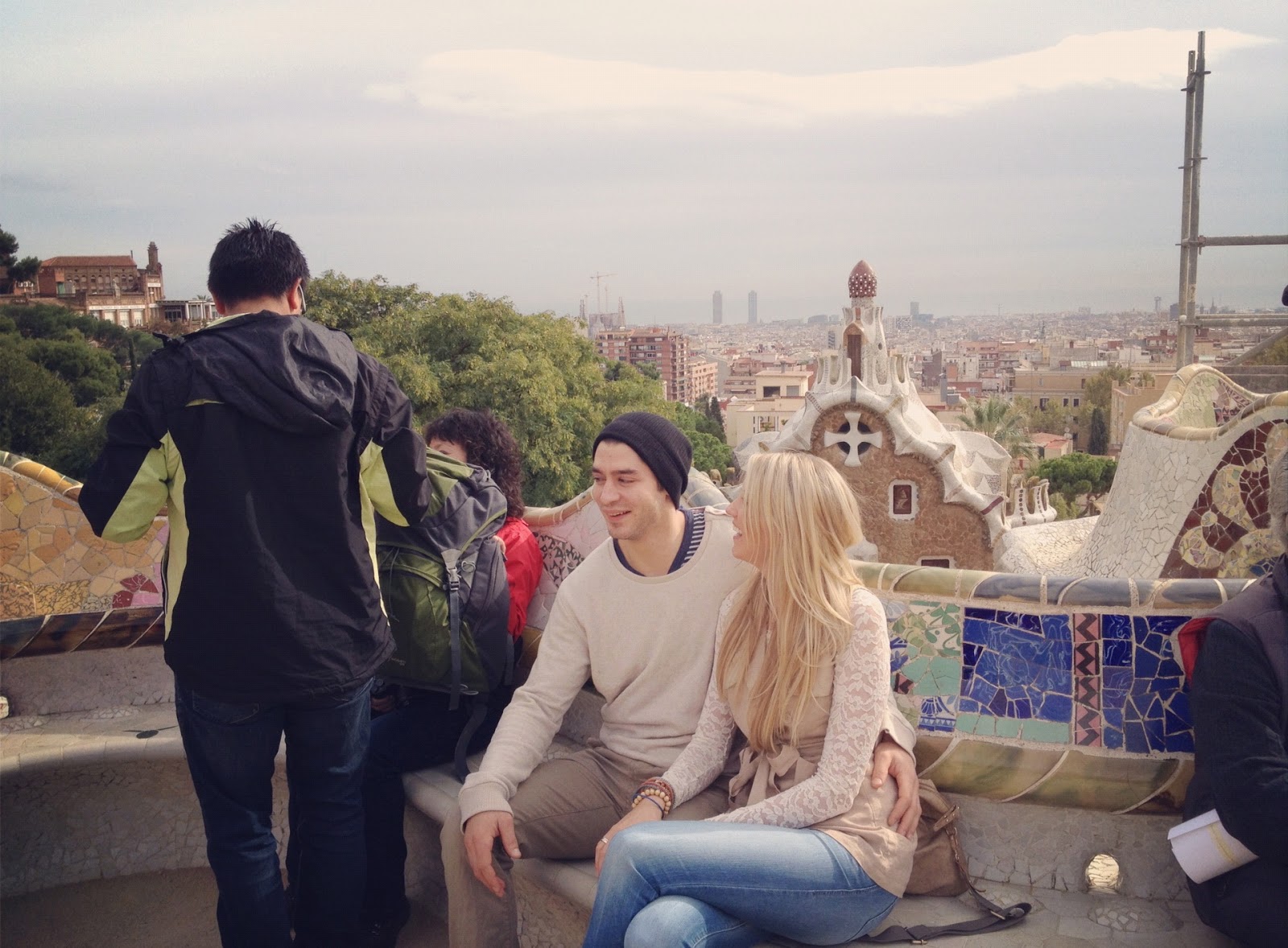

This guy really wanted to be in our picture!


Details on the window of the front entrance buildings!


Gaudi! Saw these people while we were leaving the park!


Spanish Word of the Day:
Parque meaning Park

Peace & Love,
Kevin & Amanda

Thursday, November 22, 2012

Happy Thanksgiving!


Happy Thanksgiving Everyone from Kevin and I! We miss you all and hope you have a Happy Holiday!

Kevin took off for the Czech Republic this morning he has a game there tomorrow night! It's about a 7 hour trip and they are staying the night tonight, playing tomorrow, then heading home right after the game! :) So he should be home about 6 AM on Saturday! So hopefully Kevin and I will have a Turkey dinner on Saturday!

I am thankful for my amazing boyfriend Kevin and this journey we are sharing together! I love you so much and wish you could be at home with me today! <3 I am also thankful for My family and friends that I miss dearly this Thanksgiving! Wish I could be home celebrating with all of you! Sending my LOVE from sLOVEnia! Enjoy the amazing food back home! I am jealous!

I will be going out to dinner for some Italian tonight with the girls! I am also thankful to have company on Thanksgiving with Kevin away! <3

Also in other exciting news! My mom was not messing around with sending the christmas package! Already received today on Thanksgiving! Kevin and I also got a tree last week and decorations! Already getting into the holiday spirit! Never too soon! I love Christmas!


Now I am going to watch the Thanksgiving Parade on Slingbox! :)

PEACE & LOVE,
Kevin & Amanda

Saturday, November 17, 2012

Sagrada Família, Barcelona!

This was said to be Gaudi's dream his greatest work of art! The Sagrada Família is a large Roman Catholic Church that was never even finished during Gaudi's lifetime and they are still working on it today! Although incomplete, the church is a UNESCO World Heritage Site, and in November 2010 was consecrated and proclaimed a minor basilica by Pope Benedict XVI. Though construction of Sagrada Família had commenced in 1882, Gaudí became involved in 1883, taking over the project and transforming it with his architectural and engineering style combining Gothic and curvilinear Art Nouveau forms. 


The first view of the Sagrada Familia!


Gaudí's original design calls for a total of eighteen spires, representing in ascending order of height the Twelve Apostles, the four Evangelists, the Virgin Mary and, tallest of all, Jesus Christ. Eight spires have been built as of 2010, corresponding to four apostles at the Nativity façade and four apostles at the Passion façade.


Gaudí devoted his last years to the project, and at the time of his death in 1926, less than a quarter of the project was complete.


On the subject of the extremely long construction period, Gaudí is said to have remarked: "My client is not in a hurry."


Themes throughout the decoration include words from the liturgy. The towers are decorated with words such as "Hosanna", "Excelsis", and "Sanctus";  the great doors of the Passion façade reproduce words from the Bible in various languages including Catalan; and the Glory façade is to be decorated with the words from the Apostles' Creed.


The completion of the spires will make Sagrada Família the tallest church building in the world.


Describing Sagrada Familia, art critic Rainer Zerbst said "it is probably impossible to find a church building anything like it in the entire history of art" and Paul Goldberger called it 'the most extraordinary personal interpretation of Gothic architecture since the Middle Ages'.


The Church will have three grand façades: the Nativity façade to the East, the Passion façade to the West, and the Glory façade to the South (yet to be completed).


Looks like dripping candle wax! Such an intricate design!


The three entrances symbolize the three virtues: Faith, Hope and Love.


Visitors can access the Nave, Crypt, Museum, Shop, and the Passion and Nativity towers. While visitors could previously access the towers directly at no cost, their access currently is possible only by lift and a walk up the remainder of the towers, over the bridge between the towers and descent via the opposite tower by spiral staircase.


The construction budget for 2009 was €18 million
Construction on Sagrada Família is not supported by any government or official church sources. Private patrons funded the initial stages. Money from tickets purchased by tourists is now used to pay for the work, and private donations are accepted through the Friends of the Sagrada Família.


The old and the new!

Spanish Word of the Day:
Iglesia meaning church

PEACE & LOVE,
Kevin & Amanda

Friday, November 16, 2012

Casa Milà, Barcelona!

I remember learning about this building in Design History in college and I never thought I would be able to see it for myself! Pretty amazing!

Casa Milà also known as La Pedrera, is a building designed by the Catalan architect Antoni Gaudí and built during the years 1905–1910, being considered officially completed in 1912. It was a controversial design at the time for the bold forms of the undulating stone facade and wrought iron decoration of the balconies and windows. Architecturally it is considered an innovative work for its steel structure and curtain walls, the façade is self-supporting. Gaudi wanted the people who lived in the flats to all know each other. Therefore there were only lifts on every second floor so people had to communicate with one another on different floors. Gaudi was way ahead of his time!

Our second day in Barcelona we decided to buy the bus tour because Barcelona is such a big city and all the big tourist attractions are very spread out. It also saved time and the chance of getting lost walking around! The bus tour allows you to get off at the stops you wish and walk around for as long as you want and then you can catch another bus. They come around every 5 minutes or so, so you can spend as long as you want at any destination and the bus pass is good for the whole day! First stop breakfast!


We stopped here every morning for breakfast right around the corner from our hotel! 5 euro breakfast with freshly squeezed orange juice! 


These two were there every morning eat sandwiches, drinking wine, and sharing a newspaper! We didn't wake up late this was 10 in the morning!


Eggs over easy, toast, and bacon! It wasn't listed that way on their menu we had to order it specially. They put beans as a side a lot of times in their breakfasts in Spain.


Walking to the bus stop for the tour bus!


The Barcelona tour bus cost 24 euro a person for the whole day!


The bus we took departed from Plaça de Catalunya, a large square in central Barcelona that is generally considered to be both its city centre and the place where the old city (Barri Gòtic and Raval, in Ciutat Vella) and the 19th century-built Eixample meet.


Some of the city's most important streets and avenues meet at Plaça Catalunya: Passeig de Gràcia, Rambla de Catalunya, La Rambla or Portal de l'Àngel, in addition to Ronda de Sant Pere, Carrer de Vergara or Carrer de Pelai.
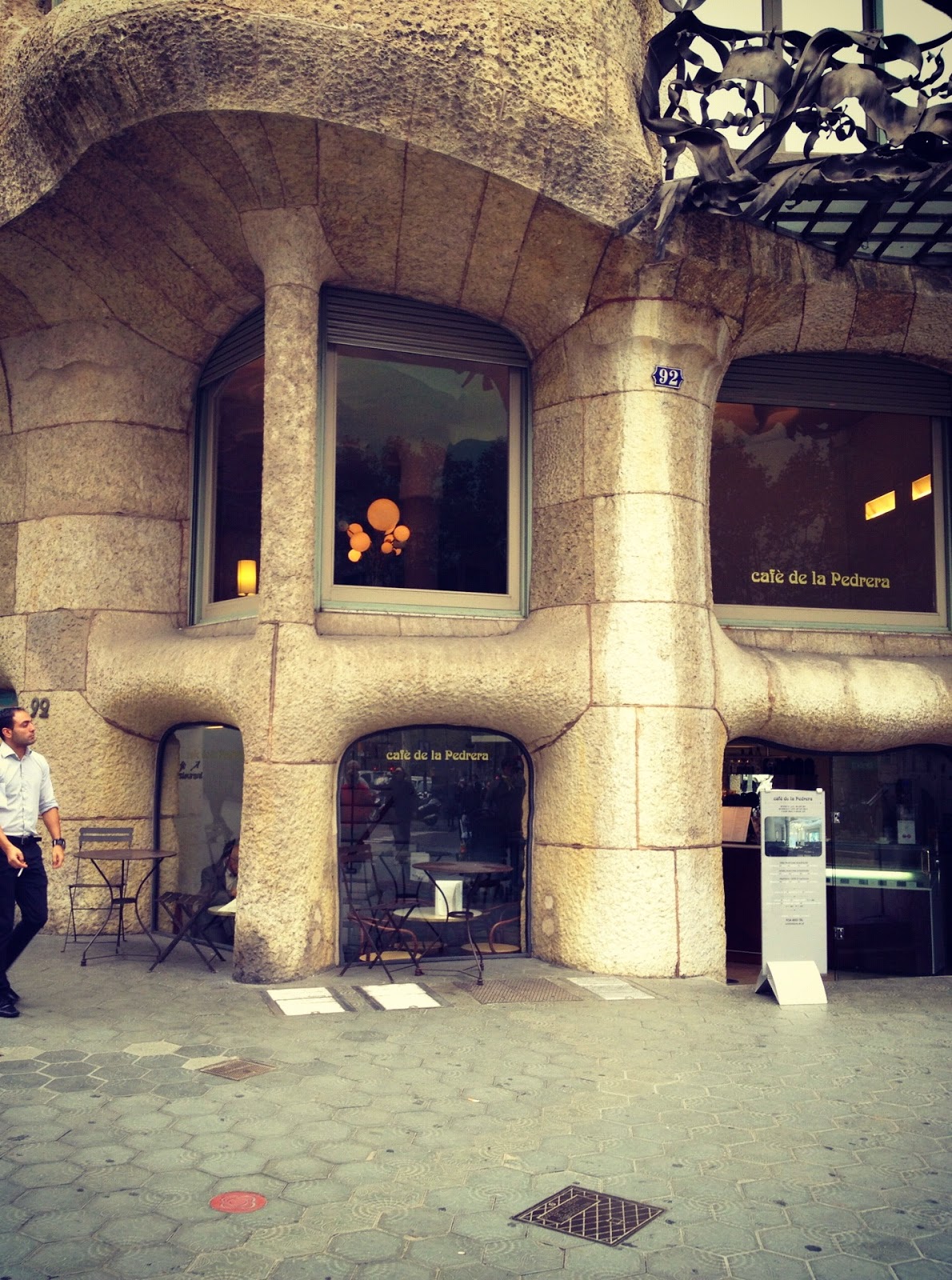

Colors of Barcelona!


On the top of the bus!


More beautiful colors! Japanese architect Toyo Ito recently transformed the facade of the wavey building, luxurious 41 apartment building in Barcelona, Spain. The architect was inspired in ‘La Pedrera’ from Gaudi that lies across the street.


Fountain!


We have made it to the Casa Milà!


These benches were all along the city! Definitely a Gaudi design or influence!


Gaudí is usually considered the great master of Catalan Modernism, but his works go beyond any one style or classification. They are imaginative works that find their main inspiration in nature. Gaudí studied organic and anarchic geometric forms of nature thoroughly, searching for a way to give expression to these forms in architecture. Some of his greatest inspirations came from visits to the mountain of Montserrat, the caves of Mallorca, the saltpetre caves in Collbató), the crag of Fra Guerau in the Prades Mountains behind Reus, the Pareis mountain in the north of Mallorca and Sant Miquel del Fai in Bigues i Riells.


Such a cool facade!


Wrought iron balconies!


Wrought iron door!


Gaudi used to say that there is no better structure than the trunk of a tree or a human skeleton. These forms are at the same time functional and aesthetic, and Gaudí discovered how to adapt the language of nature to the structural forms of architecture.


Gaudí proceeded to achieve his greatest architectural goal; to perfect and go beyond Gothic style.


Gaudí always preferred to work with casts and scale models or even improvise on site as a work progressed. Reluctant to draw plans, only on rare occasions did he sketch his works, in fact only when required by authorities. - My similarities to Gaudi I also love to build models over sketching!


"Gaudí's position in the history of architecture is that of a creative genius who, inspired by nature, developed a style of his own that attained technical perfection as well as aesthetic value, and bore the mark of his character."


The Casa Milà at night!


Loved the door!

Spanish Word of the Day:
Arquitectura meaning Architecture

PEACE & LOVE, 
Kevin & Amanda